Posted on

Why is crafting such a tough business right now?

This year I’ve noticed that it’s harder than ever to sell handmade – and having spoken to other makers, I see it’s not just me that’s having problems.

As a maker, when you have a stall at a craft fair and come home with rubbish takings, you start to question whether it’s just that your products are rubbish. You wonder if you’re wasting your time, and whether you should just give it all up and save yourself the bother. It can be really soul-destroying.

You wonder, is it the economy that’s the problem? Are people afraid to spend at the moment? The government claims that more people are in employment than ever before, but when you look closer you see that people who work 2 hours a week on a zero hours contract are considered ’employed’, so the figures are extremely misleading. Local anecdotal evidence suggests that people have either already lost their jobs or fear losing their jobs – which might explain the downturn in spending, to some degree.

And then you get a little cross at all those people who buy absolutely everything from discounter stores like B&M and Home Bargains. The need to get more ‘stuff’ for less money could well be taking cash out of the local economy and putting it in the hands of overseas shareholders. Hey, why pay for little Lleucu’s ballet lessons in Gwynedd, when you could contribute towards some anonymous overseas CEO’s umpteenth supercar?

Is it Brexit, you wonder… are people worried that leaving the EU is going to leave them worse off financially, so they’re cutting back all round? Maybe.

The thing I keep going to back to is the products I make. I have a theory about that…

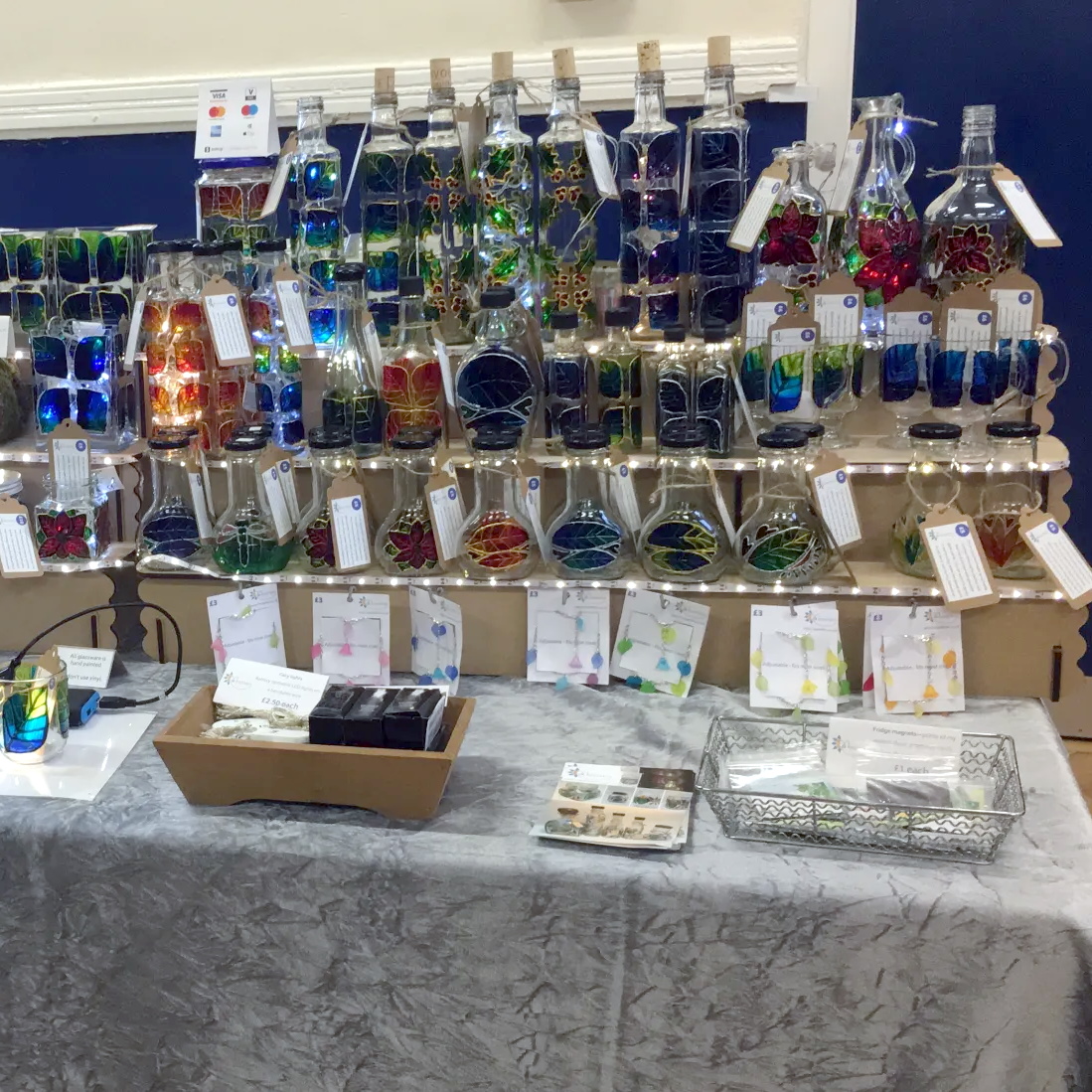
I get a LOT of people complimenting my work. At craft fairs, people will stand and chat to me for ages about my pieces, especially the painted glass. They seem to love that it’s upcycled – I tell them that I turn trash into treasure, and they think it’s a great idea. And having spent 10-15 minutes chatting to me, telling me how beautiful my work is and how talented I am, they wander off empty handed.

Why is that?

My theory is that although people love to see my brightly-coloured pieces, they don’t necessarily want them in their homes… because the fashion is for neutral colours, and people seem to like following fashion (that’s not something I’ve ever understood, if I’m honest… I relish being different). Perhaps it’s human nature to be a little nervous of being a trailblazer, a trendsetter rather than a follower of trends. What if you get it wrong? What if everyone laughs at you for having something in your home that isn’t fashionable? Not the sort of thing that would bother me, but perhaps it bothers other people.

Apart from being so skint they’re forced to buy everything from Poundstretcher so they get more for their money, the fashion thing is the only reason I can think of for people telling me how much they love my work but seemingly not enough to buy it. I’ve run Facebook ad campaigns with over 100 reactions (plus comments, people tagging their friends, etc) – but no online sales since the summer either. My Etsy shop is also dead as a door nail. Why?

Is it just me?

As it turns out – no, it isn’t just me. I’ve spoken to makers all over the UK, and 98-99% of them are saying the same thing: this has been a tough year for sales, through every channel. Some are having a slightly better time of it through online channels (like Etsy for example); but craft fairs, while well-attended, seem to be more about browsing than buying. There’s a lot of visiting for inspiration going on too, by people who want to find a new hobby (or who want to set up shop as a maker themselves). That’s why I’m extremely cagey about my glass painting technique! πŸ˜‰

What I can see happening before long is a lot of makers giving up and going back to being hobbyists. What a terrible shame for the handmade industry that would be. Do we really need to have more factory tat in our homes, when there are so many talented makers and artists out there struggling to make a living? Do we really need to have our homes filled with exactly the same stuff as everyone else?

So my plea to you, as we leave 2018 and head into 2019, is this: try to buy from small companies occasionally, instead of the big corporates. In my county, Gwynedd, the local council worked out a few years ago that if every adult spent Β£5 of their budget each week in a small business instead of a chain store, our local economy would benefit to the tune of Β£26m a year. That’s just one county. Imagine all the extra jobs that could create – people who would spend more money, and pay more taxes and boost the UK economy as a whole. Really makes you think – and if you can contribute towards little Lleucu’s ballet lessons, or little Dafydd’s football coaching, instead of buying yet another yacht for yet another billionaire… well, it gives you a nice warm feeling!

Please, do try to buy local whenever you can. If you visit a craft fair, buy something small. Even if you only spend Β£1 on my stall, when you’ve walked away I have a smile on my face and even if you can’t see it, on the inside I’m doing a little dance πŸ™‚

Speaking of which – look out next year for a cool new ‘buy local’ campaign that I’m going to be launching. More about that another time! πŸ™‚

In the meantime, I’m done with craft fairs for this year… I’ve managed to visit a few as a customer as well as having my own stall, and am happy to report that I’ve picked up several handmade Christmas presents (and some treats for myself) along the way. I’ll be spending the Christmas period thinking about whether I need to go in a different direction with Mooshkin – perhaps change what I’m making, or make more of an effort to sell through shops instead of direct – and we’ll see where that takes me in 2019.

Have a wonderful Christmas, all of you. May 2019 bring you everything you wish for!

Debs x

Posted on

Thoughts on glass decorating techniques

Painted upcycled small vinegar bottles

A little ‘outpouring of brain’ on the subject of glass decorating…

I hadn’t planned to write a blog post today, but while I was adding new products to the website a few things popped into my mind which I thought I’d share with you, in regard to decorating glassware.

Glassware decorated with vinyl

I’m sure that decorating glassware with stuck-on vinyl has its place in the world, but it’s not something that I can see myself getting into. Decoupage, possibly – but it would have to be in a way that’s really unique (not the same old serviettes that all the other decoupagers use, for example).

I’ve been a trader at dozens of craft fairs in North Wales over the past three years, and a visitor at dozens more. And at almost every one, there’s someone selling glassware that’s been decorated using vinyl.

But I don’t think I’ve ever seen hand painted glassware. And if I have, it’s certainly nothing like the designs you’ll find at Mooshkin.

I love that my work is so different to anything I’ve ever seen anywhere else. I believe – and hope – that it’s unique. When you buy a piece from me – especially an upcycled piece of glassware – you can be certain that you’re one of only a handful of people in the world to own something like it. Possibly the only person in the world to own that exact size, shape or design (because occasionally I’ll produce one-offs, or as near as dammit).

Compare this to vinyl-decorated glassware, which often sees many different makers producing almost identical items (how many more times can hackneyed quotes like ‘she believed she could, so she did’ find their way onto handmade goods, I wonder? Where’s the originality?) I’m in a massive crafting group on Facebook with over 100,000 members worldwide. I’m aware of just four members, including myself, who hand paint glass. But there are dozens, perhaps hundreds, of members who stick vinyl on glass – and many of them use almost identical designs.

I suppose I can see the appeal that some people might see in buying glass that’s been decorated with vinyl. It looks neater and crisper than hand painted, and it’s more uniform. Well, it would be, wouldn’t it? Printing off the same design an unlimited number of times, cutting it out and sticking it to the bottle… my personal feeling is that there’s little originality in this sort of thing, and the products end up looking like they’ve been rolled off a production line at a factory rather than looking handmade.

I don’t have a problem with that; if that’s what you like to buy, good luck to you! But personally, I prefer something that’s unique and which actually looks like someone had an original idea and took the time and made the effort of making it by hand. And ‘looking handmade’ also means embracing imperfections and irregularities. That’s why I don’t use templates when I paint my glassware – it’s all done freehand, by hand. I paint a lot of leaves, but you’ll never see two leaves that look identical – either in my work, or in nature (which is where I get my inspiration).

I should point out that I know I’m not like other people when it comes to choosing what to buy. Some people like to dress fashionably and decorate their homes according to the latest trends – which means they (and their homes) end up looking the same as everybody else. That’s fine, if that’s your thing – each to their own, and I swear I’m not judging! It’s just not for me. I buy things because I like them, not because a magazine told me that’s what I’m supposed to like; and I’m actually less likely to buy things if they seem to be what a lot of other people would own. I don’t dress fashionably, my hair was blue long before brightly coloured hair became a ‘thing’, and my home is as unusual and colourful as I am – beige and monotone are banned from my house! I celebrate my uniqueness, but if you’re happy blending into a crowd then that’s great too! πŸ™‚

The bottom line, I guess, is this: if you’re like me and prefer really unusual products, then you’ve come to the right place! πŸ™‚

Upcycled does not equal cheaper

I’m a firm believer that wherever possible, we should reuse instead of recycling. Although recycling is of course better than chucking rubbish into landfill, it still uses a lot of energy which harms the planet. If you can reuse an item and get a few more years’ use out of it, I really believe you should. I’ll reuse anything I can – old furniture, parcel packaging, gift wrap and ribbons (my wired Christmas ribbon collection includes some that I’ve reused for approaching 15 years!) – if I can reuse, I will.

But people do wonder sometimes why my upcycled glass isn’t sold any cheaper than my brand new glass items.

The reason is that a lot of time has to be spent in cleaning upcycled glass before I can paint on it. And when you’re a maker, time is money!

Brand new glass is often quite cheap to buy, especially if you buy in bulk.

But the time spent in soaking off labels, removing glue residue, and scrubbing glass thoroughly inside and out, means that painting upcycled glass can in some cases be more expensive than painting new glass.

Using the right materials

A final thought on the matter of decorating glass: it’s essential that you use the correct type of paint.

I overheard a couple discussing my glassware at a craft fair once, and while the woman was full of admiration for my work, her partner turned his nose up a little. I heard him whisper: “You could do that yourself with Sharpies”.

Well here’s a newsflash: using Sharpies would not give you anywhere near the same effect as my glass paints do.

First of all, the clarity and evenness of colour can’t be achieved with marker ink. The paint I use, and the technique I use for painting (which is a trade secret) mean that the colour is even, and very clear. When light shines through the paint on one of my painted glass pieces, you get pure, even, stunning colour which projects onto nearby surfaces when strong enough light is shone through it. Colours can be blended and gradated, so you’ll get (for example) a turquoise slowly becoming a dark ultramarine. This is simply not possible with Sharpies (or other marker pens for that matter).

There’s also the durability. When you use markers on glass, even when dry the ink will rub off. I’ve experimented with this just to prove the point to myself. Marker ink on glass is not durable, it’s not fade proof, and it most definitely is not weatherproof. You can’t wash it. You can try fixing it to the glass with a coat of clear varnish or clear glass paint, but this just makes the ink disappear (or at best, lose most of its pigment). It is inferior to specialist glass paint in almost every way.

So if you’re planning on giving glass painting a go yourself, make sure you invest in the right materials. My favourite brand of glass paint is Marabu GlasArt – it’s oil based, so to clean up after use you’ll need to use turps. This paint is not cheap, but it gives outstanding results… a million times better than a magic marker, in any case! πŸ™‚